
The Chicago Bears have had three different "mini-seasons" in this wild 2020 campaign. They started 5-1, with only one truly impressive win in that span. They then proceeded to lose six games in a row, including prime time embarrassments to the Rams, Vikings, and Packers, and a heartbreaking mind-number to Detroit at home.
However, since falling to 5-7, they've won back-to-back games, and looked impressive doing so. A 36-7 destruction of the Texans at home started the turnaround, and a 33-27 de facto playoff win on the road at Minnesota solidified the Bears as "still alive" for a postseason spot.
There are a couple of playoff scenarios for the Bears, but all of them require help:
- Bears win out, Arizona loses one -- Bears get seventh seed.
- Bears win one, Arizona loses two -- Bears get seventh seed.
- Bears win out, Arizona loses at least one, Tampa Bay loses two -- Bears get sixth seed.
Bears Mailbag
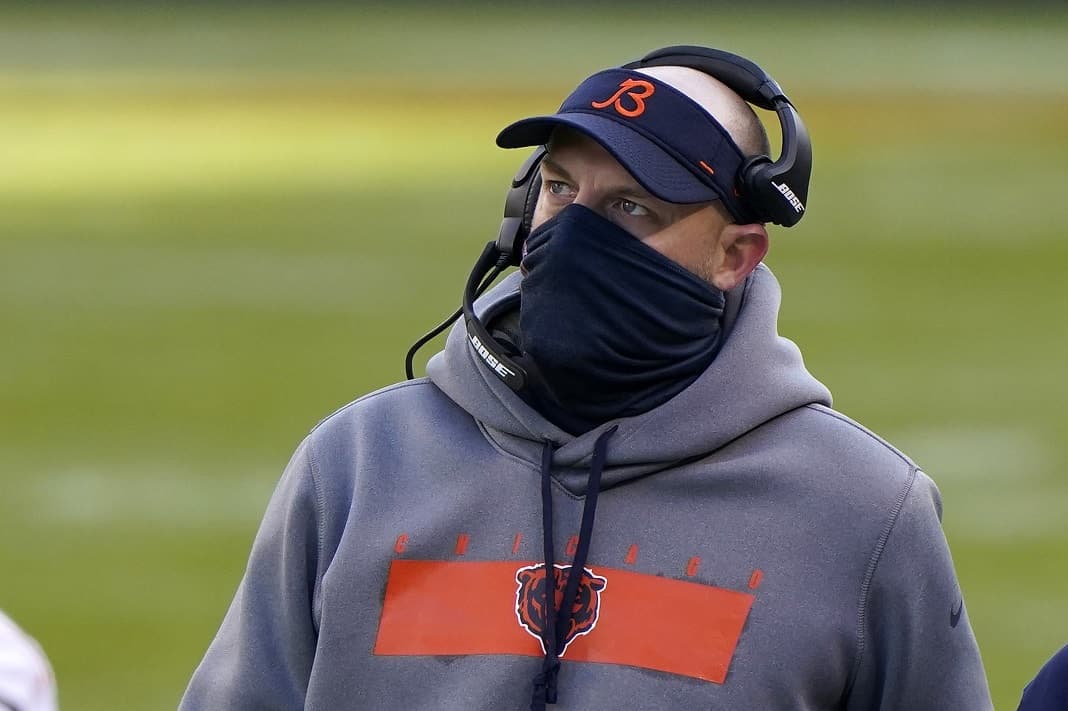
Good question. I think it requires a significantly lengthy look back. Before becoming the Bears' head coach, Matt Nagy's entire NFL career was spent learning Andy Reid's system. He saw success wherever he went -- in Philadelphia and again in Kansas City. To him, this offense worked. Donovan McNabb? It worked. Alex Smith? It worked. Patrick Mahomes? It worked. And when the Chiefs had success with him calling plays in KC in his final year there, it further reinforced his perception of the scheme. Enter Chicago. When he was hired, he wanted to modernize the Bears' offense. To him, that meant implementing Reid's system. He had a QB he thought had an upwards trajectory at the time (Mitch Trubisky), and in his first season teaching and implementing the scheme, the Bears won 12 games. It was reasonable to think the offense would grow in Year 2. So then comes 2019. The offense doesn't take the necessary steps forward, and Nagy begins to sour on Trubisky, realizing Mitch doesn't have the brain/processing power to absorb and process Reid's West Coast scheme in the NFL. So in the offseason, he revamped his coaching staff and began to design/implement a newer scheme for Trubisky (the Shanahan/McVay offense) to help bring out more production. He also, however, went and acquired a more reliable backup option -- in case Trubisky failed, he'd have someone who can implement Reid's/his scheme so the learning curve wouldn't be as high in a COVID-19 world. Fair thought. The 2020 season began, and the Bears' offense looked drastically different from 2019. The Bears were more efficient moving the ball early on, but mistakes still piled up and derailed the offense from making the requisite progress. That's when Nagy decided to bench Trubisky to see if he could unlock more production from his (more trusted) offense with a QB he thought could run it well enough (Nick Foles). Here's what happened in the Foles games:
- Furious comeback against Atlanta to win.
- Rough loss to Indianapolis, but it could've been explained by the Bears running into a buzz-saw (a great defense) and game planning specifically for Foles.
- Big prime time win over Tampa.
- Big road win over the (at the time) 3-2 Panthers.
- Awful loss in Los Angeles.
- Tough, overtime loss to the Saints where the offense looked OK.
- Awful loss in Tennessee. What happens? Nagy gives up play calling to try something different.
- Awful loss against Minnesota. They head to the bye week, realizing Foles just isn't working out, and neither is "his" scheme.
- After the bye week, Mitch is back, the Weeks 1-2 scheme is back, and the offense looks better.
I think it's a combination of things happening all at once. Injuries really hurt the offensive line early in the year -- losing James Daniels hurt a lot, as did losing Bobby Massie (surprisingly!). It took them some time, but they finally found a combination (during the bye week) that seems to work for them on the OL. Sam Mustipher has been a revelation at C, Cody Whitehair going back to LG has helped him become a dominant lineman again, Alex Bars has filled in admirably at RG, and Germain Ifedi's shift over to RT has worked wonders for him, too, despite him not working out at the same position in Seattle. At the same time is when they reverted the scheme back to the Shanahan/McVay style that they rolled out in Weeks 1-2. It's something that clearly works better with the OL they have, and the skill players they have. Fewer formations/personnel substitutions, the blocking schemes, and relying on David Montgomery (a beast of a RB) has helped things out a lot. To answer your question overall, they're both important to the success of the offense, but the scheme changes are helping highlight some good players' strengths and it's showing up on the field.
Comments
Join the discussion below. Keep it civil and focused on the content.


Loading comments...