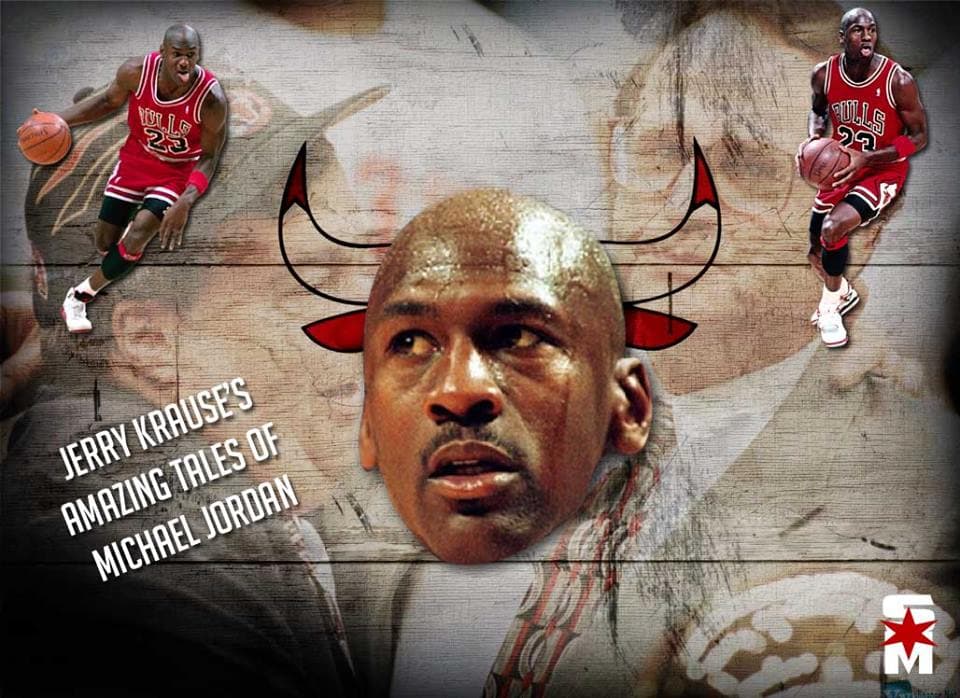
"I Was Afraid"
Just three games into his second NBA season (which was Krause's first full season as the team's GM) Michael broke his foot. He missed 64 games, but was eager to come back. Jerry, following the advice of the five different doctors he consulted, urged Michael not to come back that season. In Krause's mind, that marked the beginning of the disconnect between himself and his franchise player.When Jordan insisted on coming back, the same doctors told Krause to limit him to 10-15 minutes per game. Krause relayed those instructions to coach Stan Albeck, who followed orders and eased Michael back into action. To this day, Krause is relieved that MJ didn't re-break the bone in his foot."All five [doctors] said, 'Don't play him. Jerry, don't let him play.' ...I didn't want him to play. Michael, being Michael, said. 'That's nuts. I'm going to play.' ...There was a line between Michael and I at that point. I said, 'Michael, you work for this team. I work for this team. We are employees of this team.' He didn't like that. He got mad when I said that." - Jerry Krause
"Thank God. If Michael had broken that foot again, today [we'd be saying], 'Who was that guy, he played a year or two with the Bulls? Yeah, I remember him. But he never played after that.' And that's what I was afraid of. I was afraid that he'd break that thing again. And I was afraid that I would be the guy who gave him permission to break it. And I didn't want to be that human being. Because I could see greatness in the young man." - Jerry Krause
Something Special
Krause expanded upon that last point about greatness, and highlighted the competitive drive he saw in Michael from the beginning.Bulls fans know all about the magical things Jordan could do on the basketball court. Sure, skill and athleticism were key to his greatness. But people often overlook just how physically tough he was. Krause told one story in particular that really shed light on exactly how tough the guy was. And guess what? It's also a foot story. Weak stomachs beware..."I could see a drive in him that was different. There are very, very few people I've ever known who had a drive in them like Michael had...The arrogance that he carried with him was a plus, because he knew that he could do things that other people couldn't do." - Jerry Krause
[USE ARROWS TO CONTINUE READING]
"That's Ugly"
Krause recalled one night of a Bulls road trip in the 1986-67 season. The point he was trying to make was about Jordan's ability to play through pain. The specific example he used is pretty disgusting.Thanks to Basketball Reference, we can look it up. The sequence of games Krause referred to were back to back on December 5 and 6, 1986. The Bulls played the Suns on the 5th, as Krause stated. Jordan dropped 43 points that night, playing with a grossly swollen foot. Krause mistook San Antonio for Houston (hey, he was close) for the second game. After getting his foot cut and drained, Jordan poured in another 43 points in 44 minutes against the Spurs the next night. Okay, so it wasn't 55 as Krause suggested. Only slight hyperbole or a foggy memory. Still, the story proves Jerry's point about Michael's insane amount of physical toughness. Oh, and just to round it out: in the following three games, playing big minutes instead of resting his nasty foot, Jordan scored 40, 41 and 41. Like Krause said, never underestimate a hurt GOAT. That insane level of competition is what separated Jordan from the rest of the field. It also made it very hard to be his teammate. Krause had a new story on that front too."When Michael was hurt...don't EVER underestimate him. I saw something in a locker room in Phoenix one night. Michael had a bad foot, really had a bad one. Had puss all over his foot, it was blowing up. After the game, Paul [Steingard, Suns team doctor] came in and cut-lanced Michael's foot. Puss flew all over that table, I mean it was ugly. Doug [Collins] is standing there going, 'Oh my God, that's ugly.' I mean there's blood and puss all over. Paul drained it and he said, 'Jerry, two weeks. He can't play. Get him off that foot.' Well, Michael being Michael, cornered Doug. And then Michael being Michael, he cornered me. All he asked us to do was let him try in Houston the next night. He said, 'Let me try. If I can't do it, I won't. I'll be honest with you.' You can look the record up, it would say the next night Michael got 55 in Houston." - Jerry Krause
[USE ARROWS TO CONTINUE READING]
I Must Break You
Most Bulls fans know the stories about Jordan punching Steve Kerr or dogging Stacey King or Bill Wennington in practices. He asked a lot of his teammates, and sometimes things got heated. In his interview with Wojnarowski, Krause pulled a new example of that friendly fire out of the vault.Speaking of Kukoc, Jerry goes through the entire scouting process of the Croatian forward in his interview with The Vertical. Most of it is stuff Bulls fans already know. The skepticism from other league scouts, the Dream Team's games against Croatia in the Barcelona Olympics, etc. But Krause made a point of separating Kukoc from the rest of the players Jordan challenged. And Krause's final thought on Kukoc is very surprising."There was a fine player named Steve Colter. We traded for Steve Colter instead of drafting Johnny Dawkins. Didn't want Dawkins, thought Dawkins was going to get hurt...We brought Steve in. Steve Colter was a good guy, a good player. Michael wrecked him. Every day in practice, he just hurt him...[MJ] never said a word to me personally, but he made sure that I knew that this wasn't Johnny Dawkins. This was some guy that I had traded for and that he was going to wreck. And he did. Steve I think played another two years in the league, and was never the same player. Michael hurt him bad in practice every day, and he went after him. Just the way he did with Kukoc. Went after Kukoc the same way, but Toni responded." - Jerry Krause
Krause cried when he had to part ways with The Waiter. Wow. Fans knew Jerry's international scouting was the reason the Bulls got Kukoc, but that element of their deeper relationship hadn't really come out before. Kukoc played in the NBA until 2006, and has returned to the Bulls as a Special Advisor to president and COO Michael Reinsdorf. Now, back to Krause's relationship with Jordan, who caught the Bulls general manager completely off-guard when he retired...and came back."Michael would get on a guy. He'd say, 'You don't deserve to be here' or this or that. And he'd laugh at them, because he wanted to see the reaction. He could bring nothing out of Toni. Toni was stone-faced and played hard all the time, and he won their respect. The hardest thing I ever had to do in sports was to go to Toni Kukoc's home and tell him I traded him. Hardest thing I ever had to do. I cried." - Jerry Krause
[USE ARROWS TO CONTINUE READING]
I Quit, I'm Back
Wojnarowski asked Krause when he got the first inkling that Jordan would retire after the Bulls won their third straight title in 1993. Krause didn't see it coming at all.Krause may have been shocked, but he understood Michael's reasoning. The tragic murder of Michael's father James served as the motivation for the reigning lord of hoops to try his hands at a different sport. And Krause believes if Jordan stayed on the diamond longer, he would've done great things."I'm watching a White Sox playoff game in Comiskey Park. I'm down in the scouts section with some old friends, a kid comes up and says, 'Mr. Reinsdorf wants to talk to you up in his office.' So I went up and Jerry said, 'Michael called and he's quitting.' I said, 'What? No, no, no. Don't joke with me, that's serious shit.' He said, 'No, he's quitting, Jerr. I know in his voice, he's quitting. He's coming in here now, and he's going to quit. He thinks he wants to play baseball.' " - Jerry Krause
But Michael didn't stay in baseball. Maybe it was the taunting from his co-stars in Space Jam, or maybe it was something else. But he famously sent a fax to announce his return that simply read, "I'm back." Krause told his side of that story."Michael Jordan's father and I had a good relationship. I really liked him. James was a good guy. He had wanted Michael to play baseball originally, when he was a kid. If Michael had continued playing baseball, by the way, he might've been Willie Mays. Because he made more improvement in one year in Double A with the White Sox, it was unreal. A very good scout, who I trust, saw Michael that year in spring training and said, 'Pssh, he's got no chance. He'll have to go to low A and work his way up. Maybe in five years.' The same scout saw him 3 months later and called me and said, 'Jerry, the guy's going to play in the big leagues if he stays in baseball...this is the most amazing athlete ever. He's picked this thing up. It's amazing.' " - Jerry Krause
Not long after Jordan re-entered that gym, the Bulls fell short in the 1995 playoffs. But the addition of former foe Dennis Rodman that summer and a refreshed Michael propelled the Bulls to a record 72 wins and the franchise's 4th championship in 1996. Then came banners five and six. As Krause points out in the interview, six was "The Last Dance". Now, about that last dance. It wasn't all about Krause, nor was it all about Jordan. This, to me, was the most interesting piece of Krause's interview."When he decided to make the change and come back I didn't know he was coming back. All of a sudden one day Reinsdorf calls me and he said, 'I just heard from Michael, he wants to come back. He'll be here tomorrow.' And sure enough, Michael walked in the gym the next day." - Jerry Krause
[USE ARROWS ABOVE TO CONTINUE READING]
Break-A-Bulls
Many people like to blame Krause for the breakup of the Bulls dynasty. They say it was his personality and management style that chased Phil Jackson and Jordan away; that the core could've won more championships if Krause managed to keep them together. Krause sees it differently. And it had little do with Jordan.To Krause, it was all about the Bulls' deteriorating frontcourt. Before the 1997-98 season began, Jackson told Krause it would be his last in Chicago. And Jerry believes that Phil shared those concerns about the frontcourt, and that was his biggest reason for leaving. He wanted to go out on top."Dennis [Rodman] was dying, physically. Dennis was beat. I knew Dennis couldn't do another year, IF he got through that year. We knew Luc Longley had the bad legs. [Strength and conditioning coach] Al Vermeil told me, 'Please, no Longley. No more. Can't do it, Jerr.' We were going to be without a 4, without a 5, without a team. We were going to get beat bad the next year if we had continued with that team. And we would've had to pay a tremendous amount of money to the players who were there to continue it, and it wasn't worth it. We decided to make a change." - Jerry Krause
You'll notice Krause also mentioned Jordan's contract. In his final two seasons with the Bulls, Michael played on one year deals worth $30.14 million and $33.14 million. Krause and his boss Reinsdorf were significantly into the luxury tax, seeing as the NBA salary cap was just $26.9 million in 1998. It rose to $30 million the following season, but how much would they have had to pay Jordan to stay? $35 million? $38 million? Krause is right, the team would've struggled to replace their starting frontcourt with their nonexistent cash flow. Bulls fans can keep blaming Krause if they want to, but he's not the reason the core broke up and the dynasty ended. On the contrary, his draft work (Scottie Pippen and Horace Grant in 1987), trade work (Bill Cartwright, Rodman) and his complete restructuring of the roster for the second threepeat are the reasons that the Bulls dynasty existed. Jordan's Hall of Fame induction speech be damned, organizations do win championships. Speaking of which, Krause used this interview as an opportunity to clear the air about that whole mess."Phil told us he was going to leave. Okay, do we go to Phil and make him an offer that he can't turn down? There's always an offer somebody can't turn down. But, can we get a 5 and can we get a 4 and win? Nuh-uh. Not in our cap situation. Michael had to make $30 million a year. There was no way to get another player...So it was a question of that. There was a contract issue with Phil, but Phil wanted to get out. Phil had had enough...For one thing, Phil didn't want to coach a team without a 5 and without a 4. He knew we couldn't win. Phil is a smart man...It was a very simple decision for him. 'Hey, if I'm not going to win, I'm not going to be here. I'm not going to take the legacy I've established here and then lose.' And we would have. We would've lost. Had we done that, we would've lost for a couple of years and the thing would've been blown up worse yet." - Jerry Krause
[USE ARROWS TO CONTINUE READING]
Who Takes Credit
Jordan took a shot at Krause during his induction speech, saying, "Jerry's not here, I don't know who invited him. I didn't." He went on to cite the organizations-vs-players debate. But Krause attests that he was misquoted when the story initially hit the papers.That sounds like a fair argument. Jordan's argument of "players have to go out and play for the team to win" is also accurate, but Krause's original comment was about crediting everyone involved, players included. As for Krause finally getting recognized for his individual accomplishments - he's on the Hall ballot again this year - he insists it's about more than himself."What I said was, 'Players and coaches alone don't win championships. Organizations do.' That's true. The writer who quoted me said, 'Organizations win championships.' Period...I got ripped. First thing, the writers went to Michael and Michael said, 'What the heck is Jerry talking about? He ain't sweating out there like I am. He's not breaking his tail out there, I am.' It was not that at all. We had great people throughout the organization. We really had good people, and that's what I was trying to get at. It came out the wrong way." - Jerry Krause
Jordan got his turn to answer the Hall call in 2009. Will the general manager he constantly teased and belittled get his turn in 2017? In this author's opinion, it's long overdue. Krause is more than a retired executive with great stories about the GOAT. He helped Jordan and the Bulls become what they were: legends of their sport. You can listen to the entirety of Krause's interview with Adrian Wojnarowski below: To continue the Jordan/Krause conversation, follow me on Twitter @Bulls_Peck."Yes I have some ego - if you want to call it ego - about the drafts we made...players we drafted over the years who have made me proud for the scouting influence that I had on those drafts. Yes, it would mean a lot. I've got three grandchildren, the fourth one is about to be born in March. Grandchildren are important to me...It's important for me that they see Grampy in the Hall of Fame. Does it mean anything to me personally? It's vindication. Sure it is. But it's vindication of a lot of people...who had faith in me. That means a lot to me, an awful lot." - Jerry Krause